Pregnancy is not an illness, and it does not mean that you have to give up physical activity and yoga.
Yoga during pregnancy can help you keep, and even increase, your energy. It helps you relax and gently adjust to the changes in your body as your baby grows.
Before You Start
Read these important rules before you begin to practice:
- Get your doctor’s approval. Ask what kind and amount of activity is right for your current condition.
- Avoid overstretching. Once you are pregnant, your body starts to produce a hormone called relaxin which, as the name says, relaxes the ligaments and helps the baby pass through the birth canal. It affects not only the pelvic area but the whole body.
- Tell your instructor. If you practiced yoga before pregnancy, let your instructor know that you are pregnant (the practice should be adapted to your condition) or join a prenatal yoga class. If you practice at home, study the instructions for pregnant women carefully.
- Drink water. Hydration is especially important in pregnancy, because dehydration can be dangerous for you and your baby.
- If you practice in a general class, stay near the exit so you can leave when you need to.
In different stages of pregnancy a woman’s body needs different amounts of activity and rest.
In the first trimester, the body needs full rest and relaxation, so it is better to spend time on breathing practice, meditation and light poses.
During the second trimester, many women want to move more, strengthen the body and back and work on the hip joints, so poses with these aims get more attention.
From the third trimester, familiar poses may become harder, so props such as pillows, bolsters and blankets are used to support the body. Partner yoga is also recommended.
This article covers general recommendations and restrictions for groups of poses. Always follow your doctor’s guidance for your own stage of pregnancy.
Recommended Yoga Poses
General Guidelines
- During pregnancy every pose is done slowly and smoothly, without sudden movements and without excessive effort.
- Emphasize static positions: they support circulation in the pelvic area and strengthen the spine and muscles.
- Pay attention to stretching the legs, which helps to lower the risk of injury.
- Stop at the slightest pain or dizziness.
Three Helpful Poses

- Viparita Karani (Legs Up the Wall). A gentle pose that many women use during pregnancy to relieve tired legs. After the first trimester, support your back on a bolster or blankets instead of lying flat, and check with your doctor first.
- Baddha Konasana (Butterfly) and Supta Baddha Konasana (Reclining Butterfly). These create more space between the pelvis and the diaphragm, which makes breathing and your general well-being easier. From the second trimester, do the reclining version with your back supported, half reclined or half seated.
- Malasana (Garland Pose). An excellent pose for opening the pelvic area. Use a block or a folded blanket under the hips for support.

Your doctor or a qualified prenatal yoga teacher can give you detailed guidance for each trimester.
What to Avoid
If you have not practiced yoga before, be especially careful so that you do not add stress to your body. Increase the load gradually in any case. Every pregnancy is different, and no instructor or guide can foresee everything. If you feel the slightest pain during practice, stop the exercise.
General Restrictions
- Hot yoga (Bikram) is not recommended.
- Do not lie on your belly, and avoid exercises that strain the abdominal wall.
- Leave out jumping and fast, dynamic transitions.
- For standing balances, always hold on to a wall or a chair.
- If a pose calls for the feet together, as in Dandasana (Staff Pose), place the feet hip-width apart instead.
- In the second and third trimesters avoid deep forward folds and lengthen the spine upward from a seated position instead.
- After the first trimester, avoid lying flat on your back for long. Do the final relaxation (Savasana) lying on your left side, with a pillow between the knees.
Poses to Avoid at Any Stage
- Locust Pose (Shalabhasana) and other backbends done lying on the belly that rely on core strength;
- Marichyasana III and IV and other deep twists;
- Uttanasana, Prasarita Padottanasana and other deep forward folds;
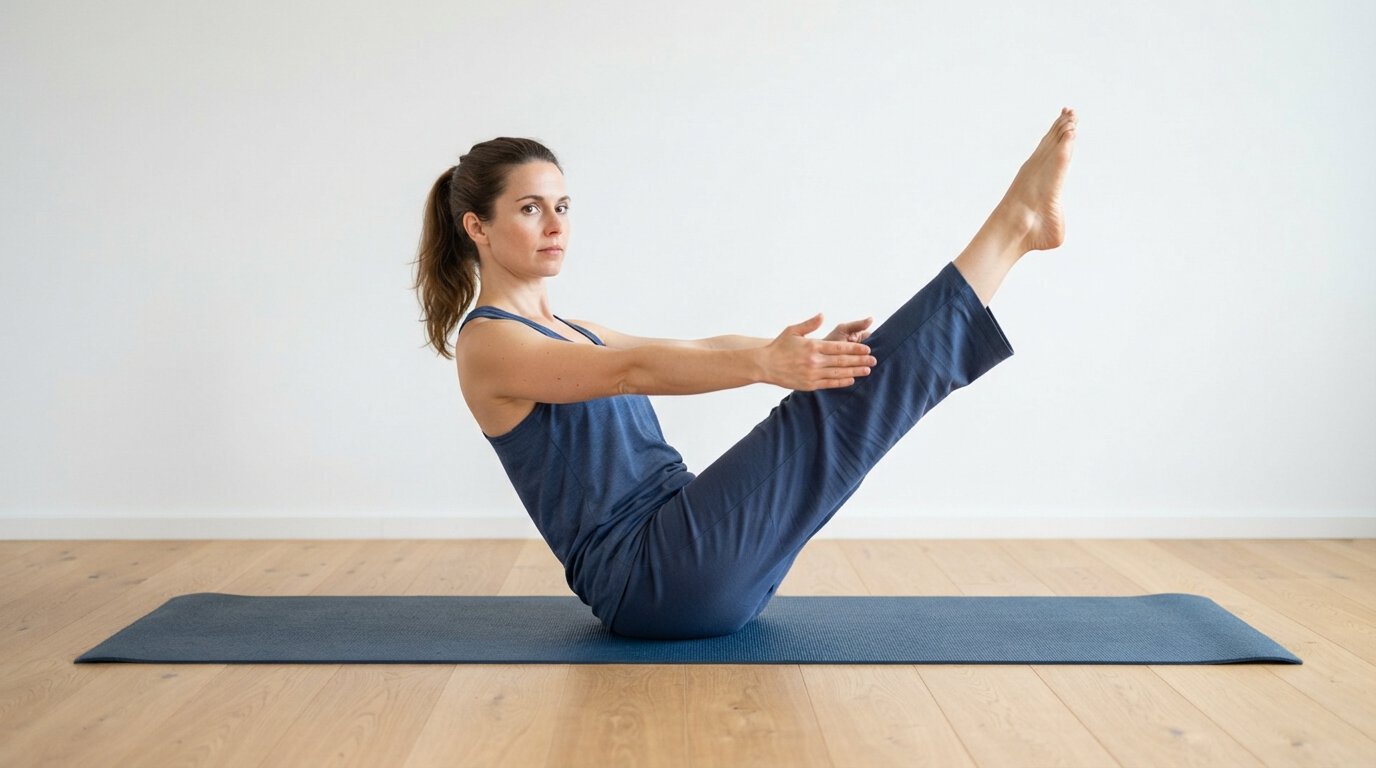
- Boat Pose (Paripurna Navasana) and similar poses that need strong abdominal effort;
- standing balances and difficult seated balances.
Poses to Modify or Replace
- Urdhva Dhanurasana (Wheel Pose). As pregnancy progresses the joints and ligaments become softer, which can make this pose unstable and raise the risk of injury.
- Adho Mukha Shvanasana (Downward-Facing Dog). As the baby grows, the center of gravity shifts and this pose can cause dizziness or nausea. Use a chair or the wall instead.
- Savasana. Do it lying on the left side.
Remember that throughout pregnancy and after birth you need to be gentle with your body because of the hormonal changes. Do not try to progress quickly: the aim of yoga in pregnancy is not to get “stronger and faster”, but to prepare for motherhood and support your health and your baby’s.
Video

The video comes from an open source on the YouTube channel YogaMammy.